AI is a source of ideas today
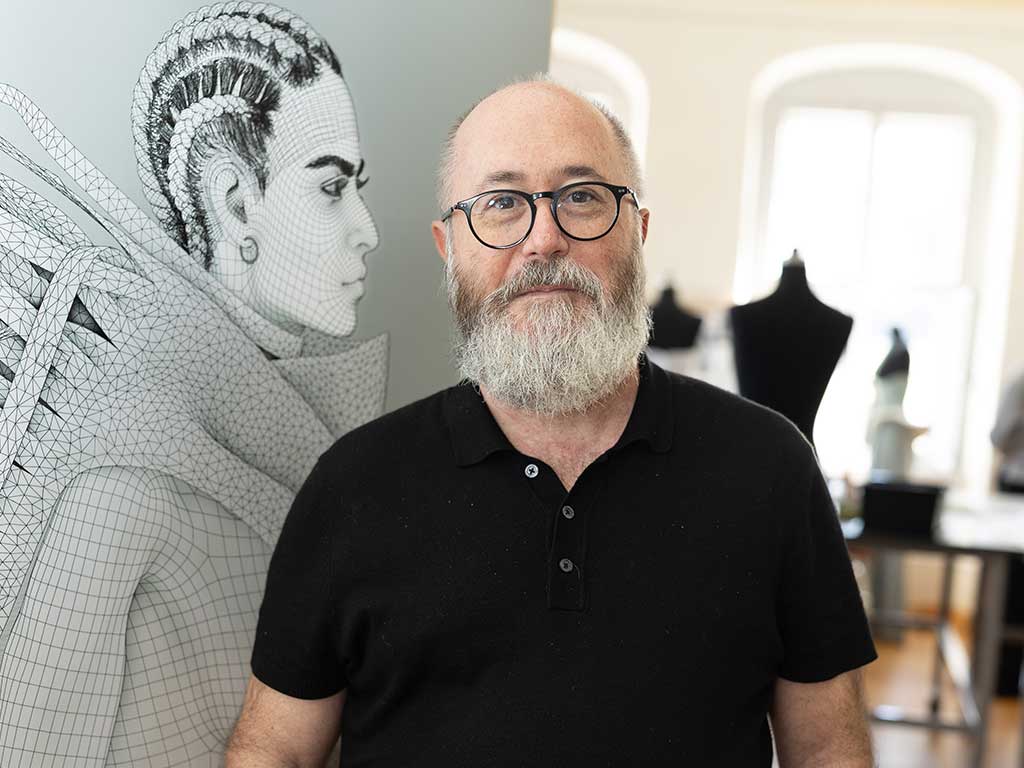
FashionTEX expert Antonio Lo Presti discusses creativity, CLO3D, and the future of fashion design. How are artificial intelligence, digital prototypes, and new forms of collaboration transforming fashion design? Antonio Lo Presti supports FashionTEX as an expert in creativity and storytelling.
He supports students—particularly in presenting their projects convincingly through personal videos. Although he was not physically present at the FashionTEX Makerspace 2026 in Riga, he followed the ongoing development of the work and contributes experience gained from the previous year’s Makerspace.
In this interview, he discusses why young designers need to experiment, why AI has long since become a creative tool, and why, for him, a Makerspace is reminiscent of the great workshops of centuries past.
Antonio, what role do you play at FashionTEX?
I am an architect, and I support FashionTEX as a creativity expert, specifically regarding the development of personal presentation videos. While I wasn’t physically present at the Makerspace in Riga this year, my task was to encourage students not just to show their projects, but to tell a story. Storytelling can help convey an idea in a way that is more understandable, personal, and engaging.
What specific skills do you want to pass on to the students?
For me, imagination and creativity come first. Technology is a tool that helps bring ideas to life. In addition to CLO3D—which plays a key role in the project—I work with software like Adobe Premiere and, increasingly, with artificial intelligence.
I find the students’ progress with AI particularly fascinating. They are improving every day in this area—in some cases, they are already a step ahead of their instructors.
What trends do you observe in the work with CLO3D?
I see clear progress. Especially compared to last year, the level of proficiency with CLO3D across the various art and design schools has risen significantly.
CLO3D is excellent for digitally simulating a sewn garment. However, things get interesting when the actual construction becomes more complex. The more complex a garment is to manufacture physically, the more challenging its digital simulation becomes. Consequently, you need not only technical expertise but also the ability to make a simulation look truly realistic.
Why is experimentation so important for young designers?
It is extremely important. You really have to work, experiment, and keep learning every day. Especially with new technologies, that includes the fact that not every attempt works right away.
Anyone wanting to work at the intersection of fashion and technology must be prepared to experiment continuously in order to keep pace with developments.
What role does artificial intelligence play in the future of fashion design?
For me, artificial intelligence is set to be one of the technologies with the greatest impact on fashion design and production in the coming years.
Digitization is already accelerating many processes today. AI can serve as a source of new ideas and act as a fast, efficient tool to help expand one’s own creativity. Programs like CLO3D, in turn, enable the rapid development and testing of prototypes.
However, everything is happening at such a speed now that we might well ask ourselves whether we actually need that pace all the time.
Can technology also contribute to greater sustainability in fashion?
Yes. Sustainability is a topic that young people, in particular, pay close attention to these days. Many consciously choose brands that handle the environment and resources responsibly. Recycling is also becoming increasingly important among young consumers.
Digital technologies can help prevent certain forms of waste—for instance, when designs and prototypes can be developed and tested digitally first.
Despite all the digitization, how important does traditional craftsmanship remain?
Very important. Fashion education should combine digital technologies with craftsmanship and knowledge of materials. At the same time, students need to learn how to handle change and continuously embrace new developments.
For me, the future doesn’t lie in replacing one with the other. The key is to combine the different possibilities.
FashionTEX brings together students from eleven European universities. What does this international collaboration mean?
Based on my experience over the past year, I can say that collaborating with students from other academies was extremely interesting. I met many young people who were already highly skilled in technology yet also remarkably open to experimentation.
International collaboration broadens your horizons. You get to know different approaches, perspectives, and possibilities. This experience is particularly valuable for young designers who will go on to work in the international fashion industry.
What distinguishes a makerspace from traditional university instruction?
A makerspace creates a new kind of place where people can come together to share ideas, knowledge, and technologies.
For me, there is even a historical precedent for this: during the construction of great cathedrals in the Middle Ages, woodworkers, stonemasons, and glassmakers would come together. They worked in a shared space, exchanged knowledge, and in doing so, developed new forms and solutions. Today, a makerspace allows us to bring together a wide variety of digital and analog technologies under one roof. People with diverse skills work together—and it is precisely this collaboration that can spark new creativity in fashion.
What do you personally take away from your work with the FashionTEX students?
Drawing on my experiences from the past year, I am particularly proud of how the young people have developed and the diverse ways in which they apply their creativity. This year, I am especially excited about the digital projects. Based on what I’ve seen so far, I expect a very high standard.
What are you most looking forward to regarding the FashionTEX Festival 2026?
Above all, the students’ results. I want to see how their digital projects have evolved and how they have combined various technologies and creative approaches.
The festival offers an opportunity to showcase this development and present the work to a wider audience.
What advice would you give to young fashion designers?
Always be ready to experiment. Technology is constantly changing—and anyone wanting to use it creatively needs to remain curious and willing to try new things.
And finally: FashionTEX Makerspace in three words?
Innovative. Efficient. Essential.