Between Nature and Object: The Deer as a Wearable Reconstruction
With “The Deer Reconstructed,” the project explores the growing distance between humans and animals in the modern era. It begins by questioning how animals are perceived today—no longer as a natural part of everyday human life, but increasingly as images, symbols, specimens, or objects of observation.
Inspired by John Berger’s essay *Why Look at Animals?*, the project places the deer at the center of its creative inquiry. Here, the animal does not represent untouched nature or romantic wilderness; instead, its form is fragmented, alienated, and transposed into an urban, human-made environment.
The result is a hybrid figure—poised between body and object, instinct and system, nature and representation. The deer is preserved, replicated, and reassembled until it ultimately becomes part of a wearable form.
This sense of distance is underscored by the choice of materials. Transparent PVC meets genuine leather alongside silicone or synthetic rubber, deliberately juxtaposing artificial and animal materials. A semi-transparent coat-dress and an outer pocket create an almost clinical, object-like aesthetic, while leather belts and an inner pocket evoke the traditional use of animal materials.
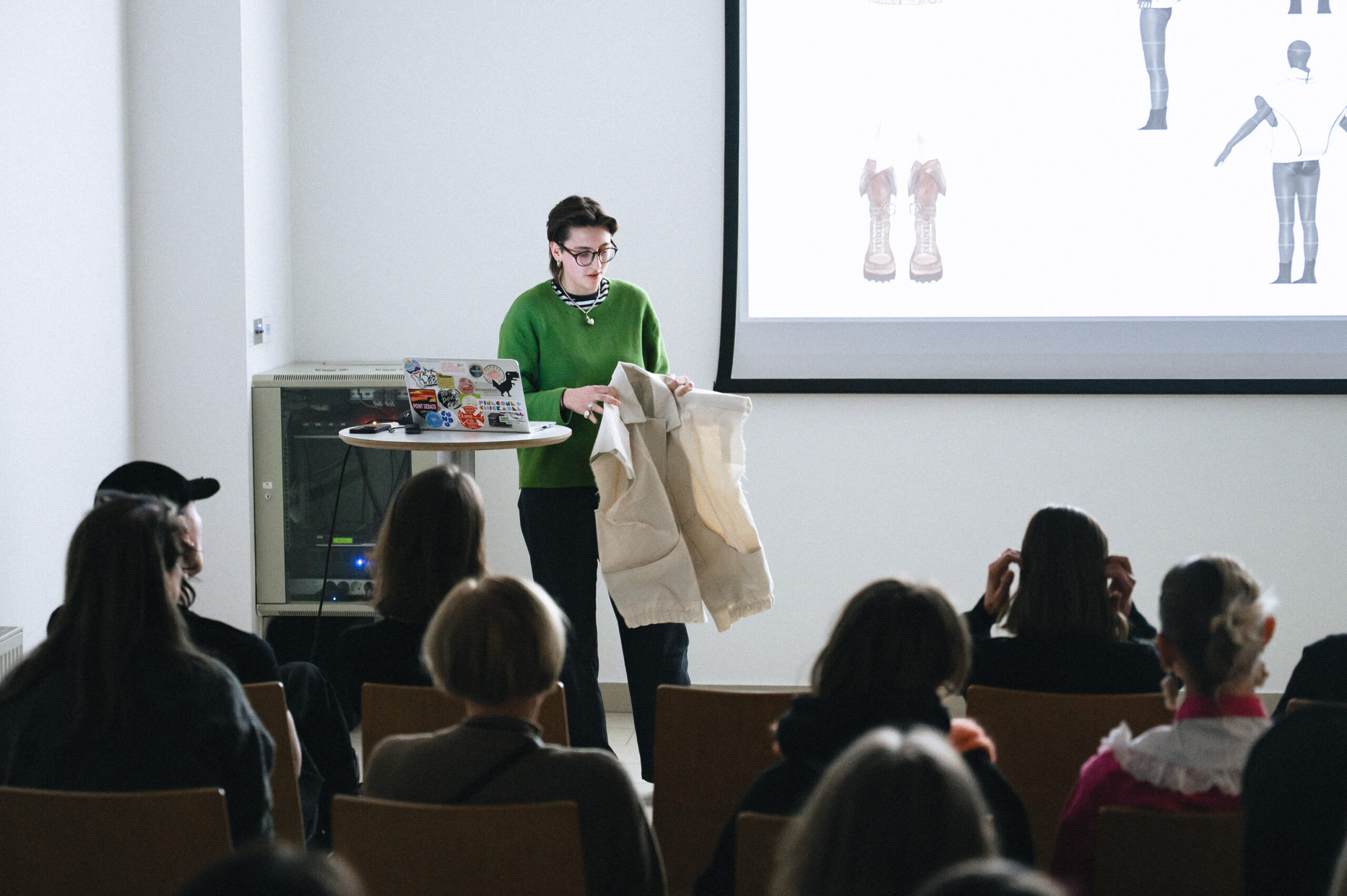
Digital technologies also play a pivotal role. A neckpiece inspired by antlers, elements of the belt, and the shoes are developed using 3D modeling and printed from flexible TPU filament. Airbrush techniques create color gradients, spots, and organic textures reminiscent of skin, traces, and deformations. Additionally, graphic or photographic elements can be applied to the PVC via UV printing.
Sewing, pattern making, and leatherworking combine these technological processes with traditional craftsmanship. The final result deliberately straddles the line between fashion, sculpture, and wearable object.
“The Deer Reconstructed” thus focuses not only on the deer itself but also on the way we perceive it. The project asks what happens when the relationship with the animal is no longer defined by proximity, but primarily by distance, representation, and reconstruction.